


If you’ve ever wandered through a wine shop on a hot day, you’ve likely been drawn to a bottle of Vinho Verde. Its sleek presentation and summery vibe are hard to miss. But if your knowledge stops at “cheap, slightly fizzy white wine,” you are missing out on one of Portugal’s dynamic and exciting wine region. As we look at the state of the wine world in 2026, let’s pop the cork on the real story of Vinho Verde.
First, let’s clear up the name. While Vinho Verde literally translates to “green wine” in Portuguese, it has dual nature, referring both to wines and the region itself. You can order um copo de Verde (“a glass of Vinho Verde”) in a restaurant, but you can make wine in the Vinho Verde region. The “green” part refers to youth, not color. These are wines historically meant to be consumed young, usually within a year or so of harvest, to capture their vibrant, zesty freshness. Think of it as the wine world’s equivalent of a crisp, green apple. Today it’s not the case with many prominent producers—with time these wines can handle ageing and become extremely complex.
Historically, the Vinho Verde name emerged in the 16th century to distinguish the high-acid, low-alcohol “young” wines of Northern Portugal from the “mature” (maduro) wines of hotter regions. While the literal translation “green wine” refers to this youthful state, it also identifies the Minho region’s lush, verdant landscape, which remains green year-round due to high Atlantic rainfall. This historical distinction was codified into law on September 18, 1908, when the Região Demarcada dos Vinhos Verdes was officially established. This transformed Vinho Verde from a general descriptor of freshness into a protected Denominação de Origem Controlada (DOC), ensuring the name specifically designates wines produced within the nine sub-regions of Northwest Portugal, regardless of whether the wine is white, red, or rosé (yes, a Vinho Verde can be red!).
A land of granite and rain, right on Porto’s doorstep
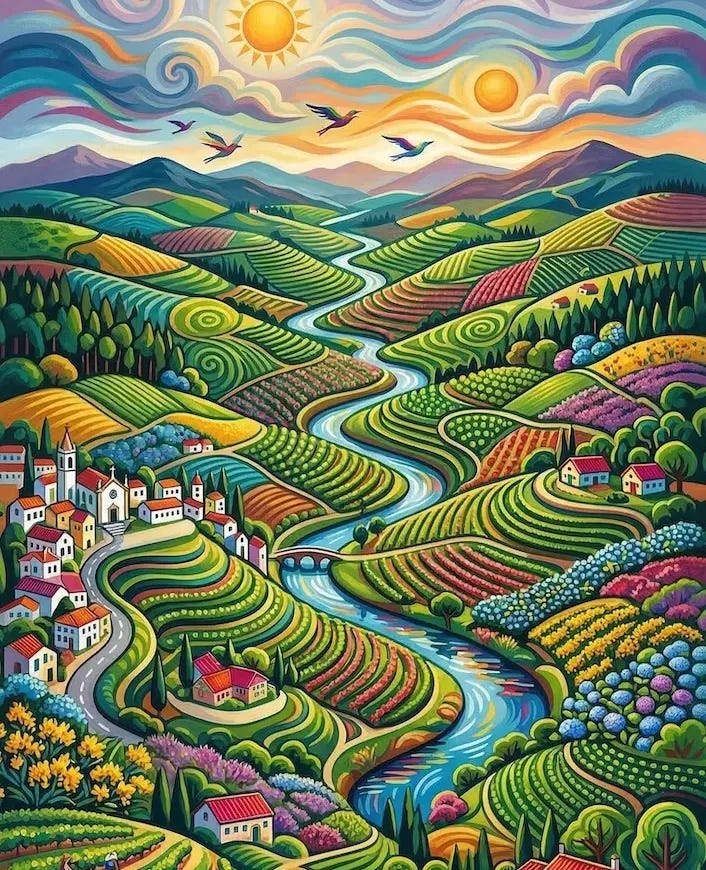
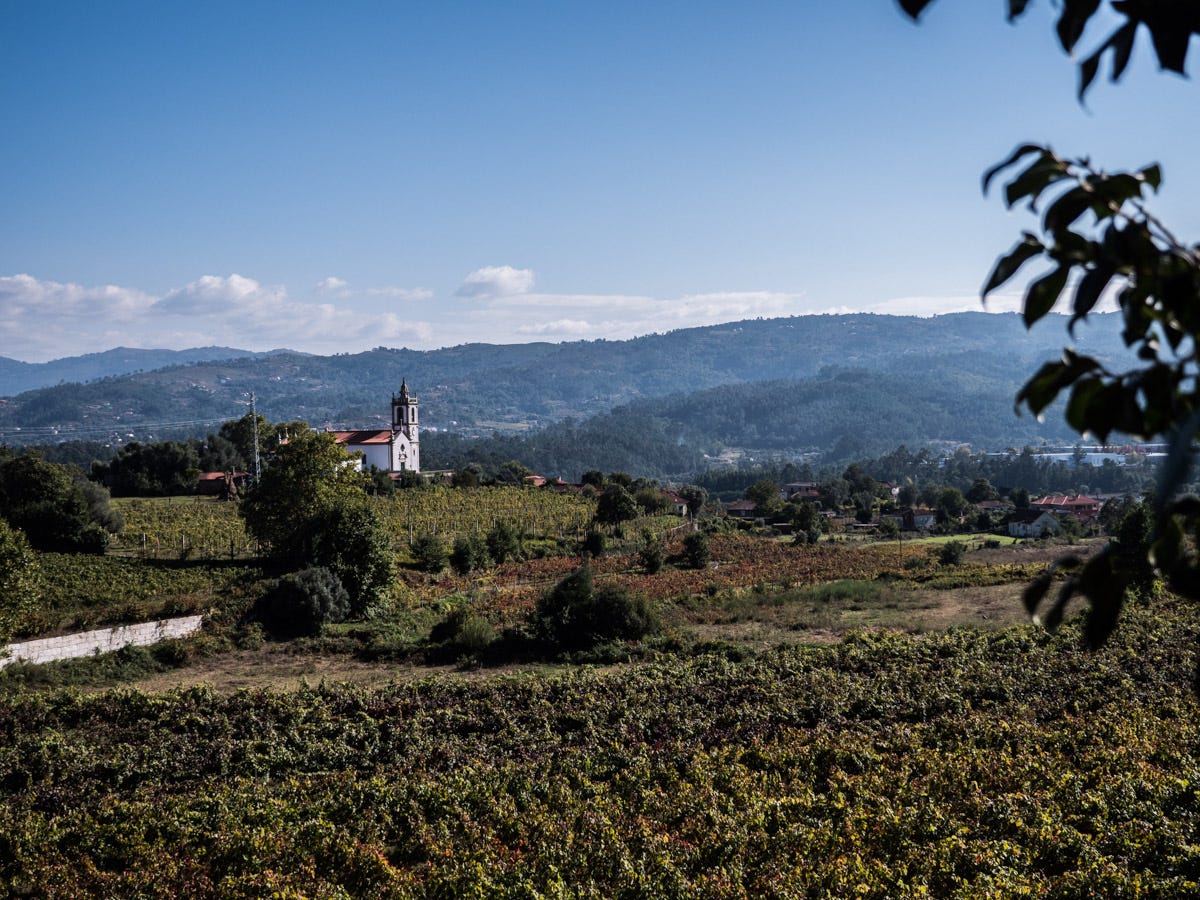
To understand the wine, you have to picture the place. The Vinho Verde region is the lush, rainy, north-western corner of Portugal, bordered by the Atlantic Ocean and the Minho River (which separates it from Spain). This isn’t a dry, scorching vineyard landscape. This is a land of rolling green hills, granite soils, and a cool, damp climate shaped by the Atlantic. This environment is the secret sauce: it allows grapes to hang on the vine for a long time, developing flavor while keeping their zingy, mouth-watering acidity.
If you are planning a trip to Porto, this is the crucial bit: you are already there. The Vinho Verde region officially starts just south of the Douro River, meaning the city of Porto itself sits on the southern border of the region. Hop in a car and drive north for twenty minutes, and you are in the heart of it. Historically, farmers grew vines everywhere—up trees, over trellises, and along fences—to free up the ground below for vegetable crops like corn. While modern vineyards now use more conventional wire trellises for better quality, that image of wild, high-flying vines is part of the region’s soul.
The whites: stars of the show
Vinho Verde is not a single grape. It’s a region producing wine from a whole family of local varieties. Here are the ones you’ll see most often:
Alvarinho (Albariño in Spain): This is the rockstar. Grown across the region, and—especially proudly—in the northern sub-region of Monção e Melgaço where it come from, Alvarinho is richer, fuller-bodied, and higher in alcohol (11.5-14%) than your usual Verde. It bursts with flavors of ripe peach, apricot, grapefruit, and a distinct saline minerality. If you want a Vinho Verde that can age and make you rethink everything you knew, look for this grape.
Loureiro: If Alvarinho is the rockstar, Loureiro is the perfumer. Its name hints at “laurel,” and it’s intensely aromatic, offering notes of jasmine, orange blossom, and lime zest. It’s often the main player in lighter, tender, floral blends.
Arinto: Known for its electric, lemon-lime acidity, Arinto is the backbone of freshness in many wines. It’s crisp, focused, and incredibly refreshing.
Trajadura: This grape doesn’t get top billing often, but it’s the crucial supporting actor. It adds body, softness, and a touch of peachy richness to blends, rounding out the sharp edges of its high-acid friends.
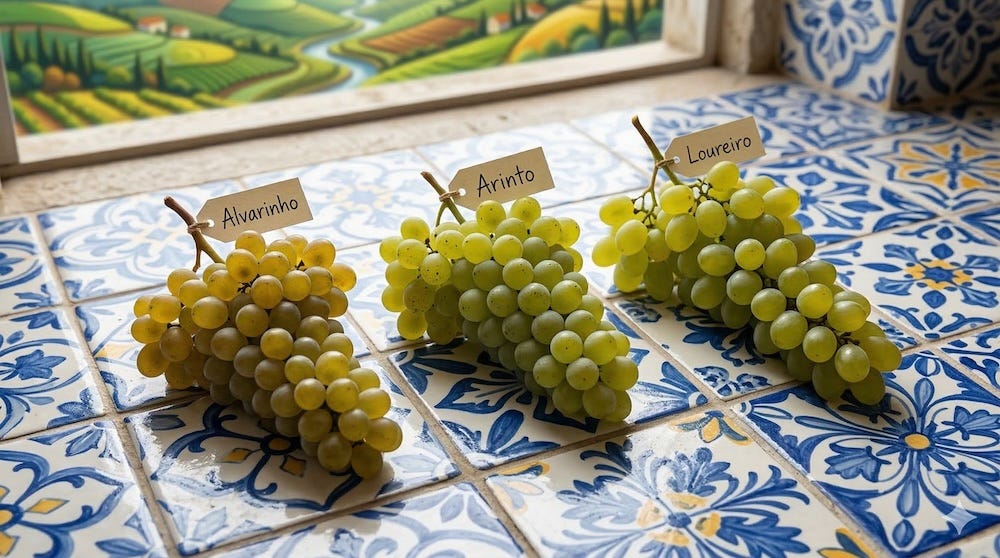
When it comes to taste, these three grapes are like members of the same band who each play a very different instrument. Arinto is the rhythm section, providing the backbone with its electric, mouth-watering acidity and bright flavors of lemon, lime, and green apple; it is the crisp, refreshing note that wakes up your palate. Loureiro is the lead singer, all about aromatic perfume, offering delicate floral notes of jasmine and orange blossom alongside pear and citrus. Alvarinho, on the other hand, is the headliner with a fuller, richer voice, delivering ripe peach, apricot, grapefruit, and a distinct saline minerality, often with a slightly higher alcohol content that gives it more body and presence. But the band does not stop there. Trajadura is the smooth backing vocalist, adding body, softness, and a gentle peachy richness that rounds out the sharper edges of its high-acid friends. Avesso, grown mainly in the Baixo sub-region, brings a fuller texture and notes of citrus and stone fruit, sometimes with a subtle smoky twist. Azal is the quiet one in the corner, offering high acidity and green apple flavors but with a lighter, more delicate structure, often used to add freshness without weight. What makes Vinho Verde so exciting is that winemakers are like conductors, blending these distinct instruments along with a cast of other local grapes permitted by the regulations—such as Batoca, Esganoso, or Cainho de Má—to create a symphony of flavors. According to the rules, a Vinho Verde DOC white wine can be a blend of any of these regional varieties, while a single-varietal wine, like one labeled Alvarinho, must be made from at least 85% of that grape.
The Reds (Don’t Ignore Them!)
Yes, Vinho Verde makes red wine. It’s a dark, brooding, and surprisingly robust style that locals love.
Vinhão: The king of Vinho Verde reds. It produces wines with a deep, almost opaque purple color, high acidity, and firm tannins. Think flavors of tart blackberries and dark cherries. It’s an acquired taste for some, but a perfect, gut-busting companion to hearty food.
The fizz factor: budget vs. prestige
Let’s address the elephant in the room: the bubbles. For decades, the entry-level Vinho Verde experience was defined by a slight prickle on the tongue. Here’s the breakdown of why it happens, and why it often doesn’t in serious wines.
In the old days, that slight sparkle (called pétillance) was a natural accident. A second fermentation would happen right in the bottle, but it also created unwanted sediment and cloudiness. Producers realized people liked the fun fizz, so they started bottling wines in opaque ceramic-like bottles to hide the mess. Today, most mass-market, inexpensive Vinho Verde gets its fizz the easy way: by having carbon dioxide injected into the wine just before bottling, similar to making soda water. It’s a harmless way to add that playful tingle.
However, the top-tier, respected producers generally don’t do this. They are crafting totally still wines. They focus on letting the pure flavors of Alvarinho, Loureiro, and Arinto shine without any carbon dioxide interference. If you buy a bottle from a small producer or a single-varietal Alvarinho from Monção e Melgaço, it will likely be completely still, allowing you to taste the true texture and depth of the wine.
The great dichotomy: tiny farms vs. big brands
One of the most fascinating things about Vinho Verde is its structure. The region is home to nearly 19,000 small growers, many of whom own just a tiny patch of land. These farmers traditionally sold their grapes to large cooperatives, which would blend them into the consistent, easy-drinking, and affordable wines that built the region’s reputation.
But a shift is happening. A new generation of “garage winemakers” and visionary estates are buying grapes or farming their own land to create single-vineyard, single-varietal wines of incredible character. Names like Anselmo Mendes, Quinta de Soalheiro, and Quinta da Aveleda are leading the charge, proving Vinho Verde can produce complex, age-worthy wines that command higher prices. So, you have two truths: the huge cooperatives making reliable, cheap, fizzy wine, and the small “rockstar” producers making profound, still, and terroir-driven bottles. Both are valid, and both are Vinho Verde.
Understanding the labels: DOC, Monção e Melgaço, and the IG Minho
Reading a Vinho Verde label can be tricky because you have different levels of quality and geography at play. Here is the cheat sheet.
At the top of the pyramid, you have the DOC Vinho Verde. This stamp, overseen by the national Instituto da Vinha e do Vinho (IVV), guarantees the wine comes from this specific region and follows strict production rules. Think of it as the official seal of authenticity.
Now, within that DOC, there are nine special sub-regions. The most famous by far is Monção e Melgaço. Located in the far northwest, hugging the Spanish border, this area has a unique microclimate that is warmer and more sheltered than the rest of the region. Because of this, it has earned a special status. When you see “Monção e Melgaço” on a label, it means the grapes come exclusively from there. The rules here are even tighter, and the wines (almost always pure Alvarinho) are allowed to have a higher alcohol content. It is the cru (a French term for a top-tier vineyard area) of Vinho Verde. In short: All Monção e Melgaço wines are DOC Vinho Verde, but not all DOC Vinho Verde wines are Monção e Melgaço.
Finally, you might see IG Minho (Indicação Geográfica). This is a broader, regional classification. Wines labeled IG Minho are from the same general area but have more flexibility. Winemakers might use grape varieties not permitted in the stricter DOC rules, or they might experiment with different winemaking styles. It is the “playground” for innovation, often resulting in fresh, modern wines that might be labeled by grape variety and offer a different expression of the Minho landscape. IG Minho is also standard for many young “natural” winemakers, whose tasty wines don’t fit the region’s official stylistic narrative.
Read a Vinho Verde label like a pro
The label is your treasure map. Here’s how to decode it:
1. The Name: Look for “Vinho Verde” or “Minho”. This is your guarantee of origin.
2. The Quality Stamp: This is key. If it says “Denominação de Origem Controlada” (DOC), it means the wine meets the strict regulations for the region. The regulatory body, the Instituto da Vinha e do Vinho (IVV), oversees all of this, ensuring the standards are met. You might also see “IG Minho” for wines with slightly more flexible rules.
3. The Sub-Region: If you see a specific name like “Monção e Melgaço” or “Lima” on the label, it means the grapes come from one of the nine specific sub-regions, each with its own micro-climate. Besides the price, this is usually a sign of a more serious wine.
4. The Grape Variety: If it says “Alvarinho,” you’re getting a rich, full-bodied wine. “Loureiro” means floral and aromatic. If it just says “Vinho Verde Branco,” it’s likely a classic blend of grapes like Loureiro, Trajadura, Arinto and others.
5. The Producer: Is it a “Quinta” (a specific estate or farm)? This often suggests a single-property wine with a distinct personality. A cooperative name usually means a reliable, entry-level blend.
6. The Vintage: You’ll almost always see a year (e.g., “2025”). Vinho Verde is meant to be drunk fresh, so that year is likely the harvest. Look for fresh vintages in cheaper wines, but don’t be scared to try aged Verde, because, boy, the best of them age surprisingly well.
So, next time you’re browsing the shelves, don’t just grab the cheapest bottle with the cute label. Look for the Alvarinho grape, seek out the Monção e Melgaço sub-region, and maybe try a still red Vinhão. You’ll discover that Portugal’s “green wine” is a region of deep tradition, modern innovation, and incredible diversity, just waiting for you to explore. Cheers! Saúde!