


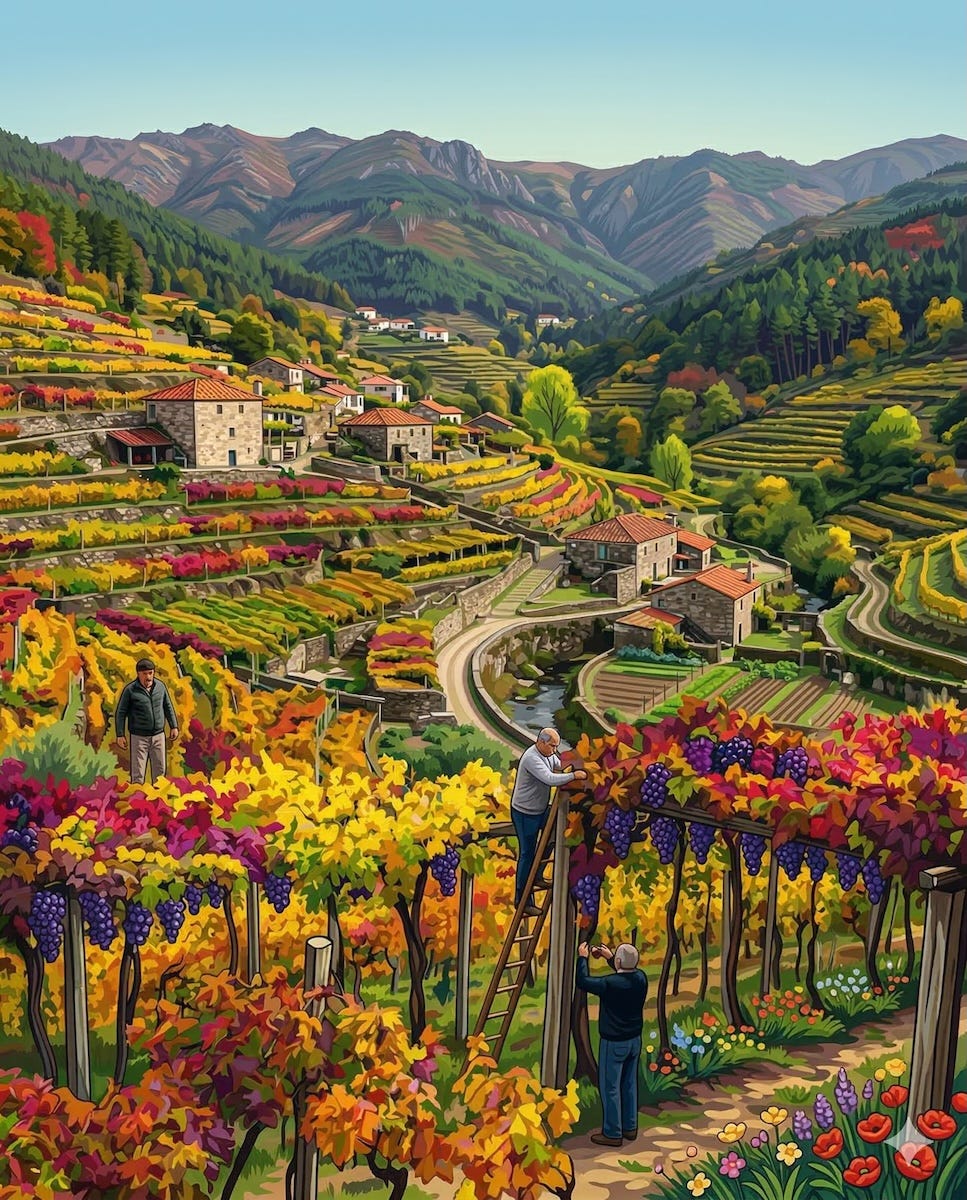
Imagine a vineyard where grapevines don’t crawl along wires at waist height, but climb towards the sky, their branches intertwining with living trees that soar four metres or more above the ground. This is the vinha de enforcado—the “hanged vineyard”—an agroforestry system originating in medieval Portugal that represents one of Europe’s most ingenious responses to agricultural scarcity.
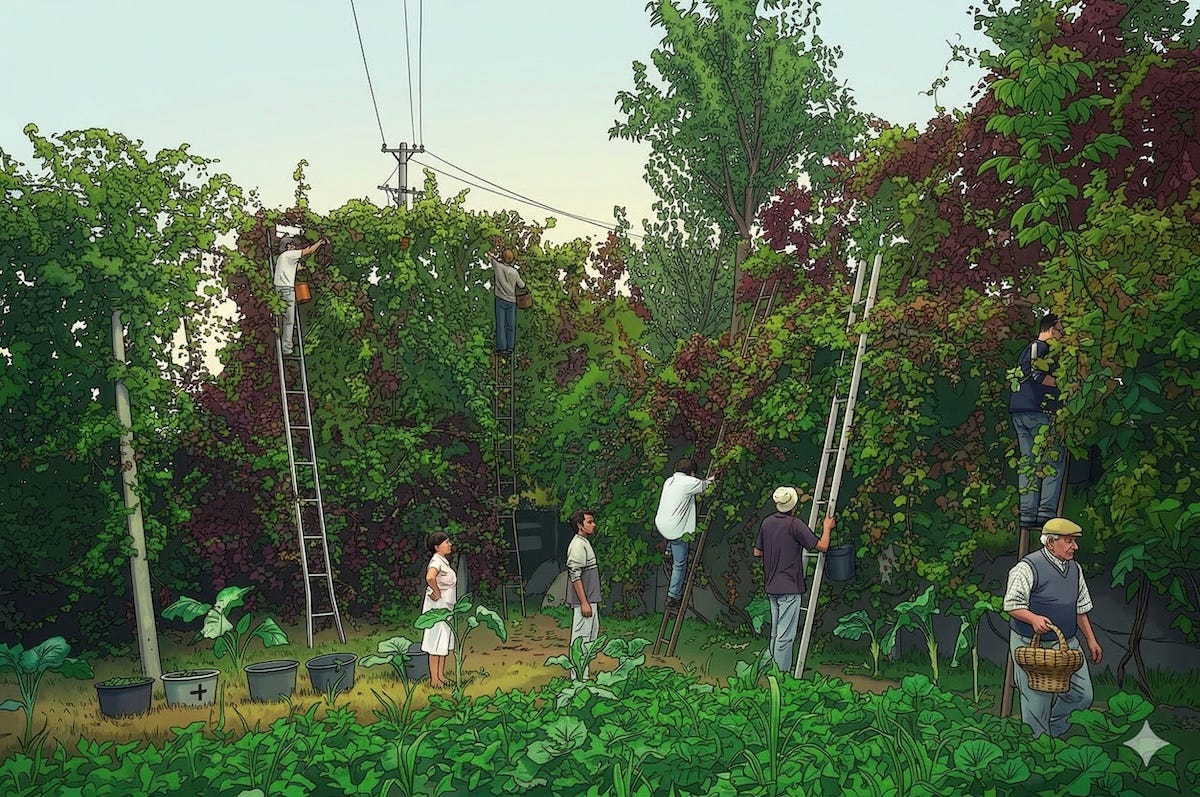
The name evokes a striking image: vines literally hanging from their arboreal supports, suspended in the air like nature’s chandeliers. For centuries, this system allowed Minho’s farming families to extract maximum value from their limited land. While the interior of each plot was dedicated to subsistence crops—maize, vegetables, or forage for livestock—the borders were lined with trees that doubled as living trellises for wine production. The trees selected—sysamores, hackberries, ashes, and poplars—were specifically chosen for their ability to withstand annual coppicing, a practice that simultaneously provided animal fodder and controlled the shade that would otherwise compromise grape maturation.
The Art of Sky-High Viticulture
The vinha de enforcado demanded a viticultural vocabulary all its own. The grape varieties that thrived in this system—names like Azal, Espadeira, Borraçal, Sousão, and Verdelho—evolved distinct characteristics: vigorous vertical growth patterns, remarkable shade tolerance, and organoleptic profiles that set them apart from their ground-dwelling cousins. These vines produce wines that are naturally higher in acidity and lower in alcohol, creating a style that one researcher describes as “less inebriating” than modern intensive plantings. The harvest itself was a spectacle of agricultural daring. Workers ascended tall ladders reaching towards the canopy, becoming what one writer poetically termed “birds of paradise without wings,” steadying themselves with calloused hands while wooden clogs hooked onto ladder rungs, reaching into the foliage to free the hanging clusters. This dangerous, time-consuming work—combined with expensive maintenance and the low prices paid for grapes—has pushed the system to the brink of disappearance.
A Vanishing Legacy Under Pressure
The statistics are sobering. By 2017, a survey in the Vale do Sousa—one of the last strongholds of the vinha de enforcado—found a single farmer still actively maintaining one hectare of this traditional system alongside his modern plantings. The pressures are multidimensional: labour shortages make the perilous ladder harvests increasingly unfeasible; European agricultural policies through the VITIS programme actively incentivise conversion by granting three square metres of planting rights for every square metre of enforcado removed; and the relentless march of intensive viticulture favours uniform, mechanised vineyards over these complex agroforestry mosaics. Yet the system’s advocates argue passionately for its preservation. Beyond the wine itself, these vineyards harbour unique biodiversity—birds and bats find refuge in the layered structure—and represent an irreplaceable cultural landscape that some believe merits UNESCO recognition. A 1610 reference in Duarte Nunes de Leão’s “Descrição do Reino de Portugal” already distinguished between the vinho de enforcado destined for “common people” and the vinho em bardo reserved for nobles, demonstrating how deeply this system was woven into the region’s social fabric.
Modern Guardians of an Ancient Tradition
Despite the challenges, a new generation of producers has recognised that these ancient vineyards offer something the modern wine world craves: authenticity, storytelling, and genuine distinctiveness. The Vinho Verde region’s official commission acknowledges that while the overwhelming majority of vineyards are now planted continuously in dedicated plots, the surviving enforcado and ramada systems allow smaller producers “to bet on the differentiation that these old vineyards provide to offer truly singular wines”. Among the most prominent champions is winemaker Márcio Lopes, whose Pequenos Rebentos Selvagem emerges from a vinha de enforcado in Telões, Amarante. Working with the challenging Azal variety—a late-ripening grape producing clusters so compact they’re particularly vulnerable to rot—Lopes has developed a meticulous approach involving substantial leaf removal at flowering and significant green harvesting in July to advance maturation before autumn rains threaten the crop. His winemaking respects the grape’s inherent character: fermentation in raw clay amphorae allows calcium release to precipitate tartaric acid and tame the variety’s naturally high acidity, while ageing in porous Portuguese oak barrels softens Azal’s reductive tendencies.
The Taste of a Landscape
The vinha de enforcado produces wines that taste like no others because they are expressions of a farming system, not just a grape variety. When you drink a bottle from these hanging vines, you’re tasting the complex interactions between tree and vine, the particular microclimate created by elevation, and the genetic memory of varieties selected over centuries for their ability to thrive in this unique environment. The Azal-based wines carry the signature of their origins: bright acidity balanced against surprising texture, with an aromatic profile shaped by the canopy that shelters them. The Pequenos Rebentos Selvagem represents just one interpretation; other producers in the Sousa Valley and surrounding areas are slowly rediscovering the potential of varieties like Espadeiro and Borraçal grown in this traditional system. These wines offer an alternative narrative to the homogenisation of global viticulture—a story not of maximum yield and uniform ripeness, but of adaptation, survival, and the stubborn persistence of a farming wisdom that understood that sometimes the most sensible place to grow grapes is exactly where they’ve always grown: high up, hanging from trees, dancing with the wind.