


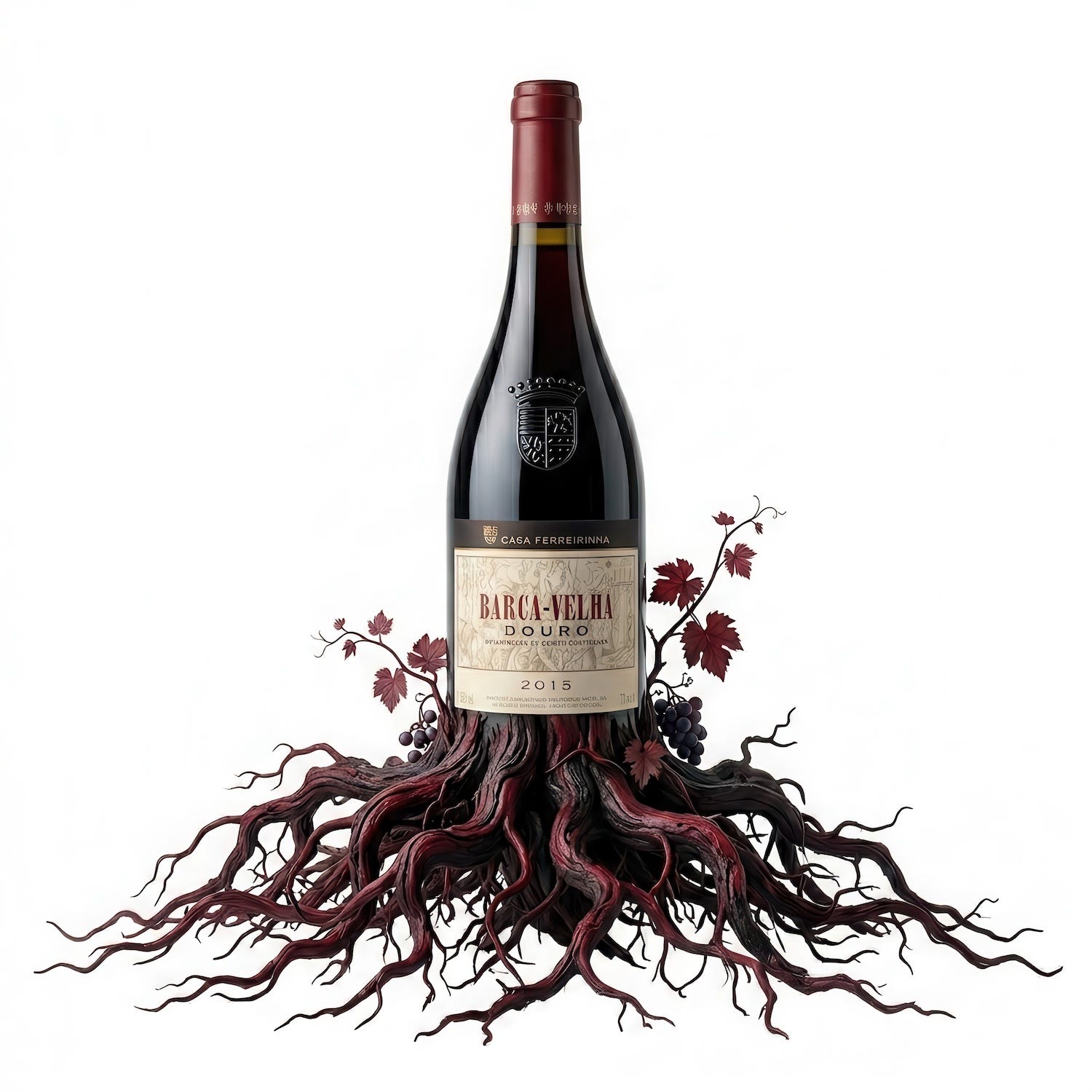
Portugal in 1952 was not short of wine, but, rather, wine with ambition. Then, in a Douro built for Port, Fernando Nicolau de Almeida made a dry red that had no obvious market, no easy technical path, and eventually no real Portuguese rival.
Under Estado Novo, the country drank locally, cheaply and without much ceremony. Wine was food, fuel, habit, sometimes comfort, occasionally punishment. A lot of it moved in bulk, in demijohns, in anonymous bottles, across tables where nobody was searching for cassis, graphite or the inner life of a granite slope. In the north, Vinho Verde was light, sharp and rustic. Dão and Bairrada had old potential but not yet the modern polish. Alentejo was not yet the well-fed prestige machine it would later become. The Douro, meanwhile, had one job in the national imagination and it performed it very well: Port.
Into that world came Fernando Nicolau de Almeida, a Ferreira man, a Port man, and therefore exactly the wrong person to ignore the rules.
He was not a romantic outsider arriving with a notebook and a foreign accent. He belonged to the wine trade. His family background was stitched into Port: his great-grandfather had founded António Nicolau de Almeida Júnior & Irmão, a Port-exporting firm later absorbed into Real Companhia Velha, and his son João Nicolau de Almeida would become one of the major modernizing figures at Ramos Pinto.
Fernando worked at Casa Ferreirinha as technical director, winemaker and taster. He knew Port from inside the machine: the harvest, the fortification logic, the tannin, the colour, the patience, the blending, the long view. This is why his disobedience was interesting. He wasn’t rejecting the Douro because he didn’t understand it. He was challenging it because he understood it too well. Fernando Nicolau de Almeida’s move was similar to that of Max Schubert’s of Penfolds in Australia, though very Portuguese in its inconveniences. He also looked to Bordeaux, not as a costume to copy, but as proof that red wine could be built for time: selection, structure, acidity, ageing, repeated tasting, refusal to release before the wine had earned its face.
In the Douro of the early 1950s, this was close to professional mischief. The region had heat, schist, old vines and dark grapes, but most of that power was channelled toward fortified wine.
A dry red from the Douro could easily become a boiled animal: impressive for five minutes, dead by lunch. Nicolau de Almeida’s problem was not how to find concentration. The Douro hands that out in warm years like a corrupt official. His problem was freshness.
So he went looking for altitude. The Douro Superior, around Vila Nova de Foz Côa and the Ferreira-owned world of Quinta do Vale Meão, gave him the material. Lower, warmer vineyards could provide body, color and tannin. Higher, cooler parcels—some reaching several hundred meters—could bring acidity and the tension needed for ageing. Barca Velha (short, BV) was not born from one magic plot. It was a constructed answer to a difficult question: how do you make a dry Douro red that survives its own climate?
The first vintage, 1952, sounds less like the birth of a luxury icon than the setup for a very expensive agricultural farce. The grapes were not destemmed because the equipment was not available. Cooling was improvised with ice brought at night from Matosinhos to the Douro Superior. The trip itself says enough about the era. Today, a winery mentions “temperature control” and one imagines stainless steel, buttons and a consultant looking emotionally unavailable. In 1952 it meant moving ice across northern Portugal so the experiment didn’t cook itself to death.
The first recorded production was tiny: 17 half-pipes of 225 liters. The wine had the philosophy of Vintage Port behind it—selection, longevity, severity—but it refused the spirit. It wanted the Douro’s body without Port’s fortification, its depth without sweetness, its old-vine gravity without the trade category that had made the region famous. This was the betrayal hidden inside the inheritance.
Even the name carries river dust. Barca Velha means “old boat” or “old barge,” a nod to the Douro world of transport and trade. Behind it stands Casa Ferreirinha and the long shadow of Dona Antónia Adelaide Ferreira, the nineteenth-century matriarch who expanded and strengthened the family’s Douro holdings. Quinta do Vale Meão, which she bought in 1877, became one of the great estates of the Douro Superior and part of the Barca-Velha origin story. The wine was not a modern brand parachuted into the valley. It came from the old Ferreira bloodstream and then committed the family name to a new species.
For decades, BV was almost alone in making that argument. The Douro DOC for unfortified wine only arrived in 1979. By then it had already been saying the unsayable for more than twenty years: the Douro could make a great dry red. Later, the valley would fill with answers—Quinta do Vale Meão, Quinta do Crasto’s old-vine reds, Niepoort’s Batuta and Charme, Pintas, Poeira, Chryseia, the Douro Boys and many others. But Barca-Velha was there before the room filled up, standing by the door with the expression of a man who had brought the body.
Its scarcity is part of the method. Casa Ferreirinha doesn’t declare Barca every year. A wine can begin life with that ambition and be demoted to Reserva Especial, or not released under either name. The decision comes after years of tasting and watching. Since 1952, only 21 vintages have been declared, with the 2015 released in 2024 after long ageing. The current technical custodian is Luís Sottomayor, head of winemaking since 2007, who inherited not just a wine but a standard: power must come with freshness, polish with endurance, Douro density with enough nerve to keep breathing.
The blend still speaks Douro rather than fashion. Touriga Franca, Touriga Nacional, Tinta Roriz, Tinto Cão and sometimes Sousão form the grammar. Touriga Nacional gives perfume and authority; Touriga Franca brings dark fruit and structure; Tinta Roriz adds flesh and spice; Tinto Cão helps with acidity and longevity; Sousão gives color and bite when used. The finished wine should not taste like a grape roll-call. At its best it has black fruit, dry herbs, tobacco, cedar, olive, warm stone, firm tannin and, with age, leather, balsamic notes and earth. Not small. Not breezy. Not a first-date wine unless the first date includes inheritance planning.
The modern price is the awkward witness. Barca Velha 2015 sells in Portugal at roughly €850–€900, sometimes more. For pure drinking pleasure, this is where reason quietly leaves the building. Portugal now offers superb reds for far less money: Vale Meão for historical Douro depth, Pêra-Manca Tinto for Alentejo grandeur, Crasto single-vineyard reds for old-vine concentration, Niepoort for tension and intelligence, Bairrada and Dão for structure without the auction-house perfume. Anyone buying BV as a rational value purchase may also be interested in a reasonably priced bridge.
But the wine is not usually bought to win a spreadsheet. It is bought because the occasion needs a bottle with history already inside it. For an older Portuguese wine lover, Barca Velha can carry memory as much as flavor. For a couple marking a serious anniversary, it can turn dinner into a small ceremony without requiring speeches, which is merciful. For a sommelier, it can anchor the story of the Douro’s shift from Port country to table-wine power. For a collector, it remains one of the few Portuguese dry reds with national myth, age record and release discipline in the same bottle.
It is also easy to waste. Opened too young, too loudly, for people who only want the label, BV becomes an expensive prop. It needs time, good glasses and food with enough depth to meet it: lamb, game, roast kid, aged beef, mushrooms, truffle, hard cheeses, proper Portuguese cooking. Mature bottles deserve a room willing to listen. Young bottles deserve a cellar, or at least a host with patience and a corkscrew not bought at a petrol station.
The secret of this wine is not that it is Portugal’s best red in every vintage, at every table, for every drinker. That would be boring and objectively false in the subjective wine world. Its secret is that it changed the direction of Portuguese wine before the market knew the direction existed. Fernando Nicolau de Almeida took a Port valley, borrowed the long-ageing seriousness of Bordeaux, dragged ice across the country, trusted altitude before it became a fashionable word, and made the Douro answer a question almost nobody had asked out loud.
Some wines are expensive because somebody invented a story for them. Barca Velha is expensive because the story came first, and the wine kept turning up with evidence.