
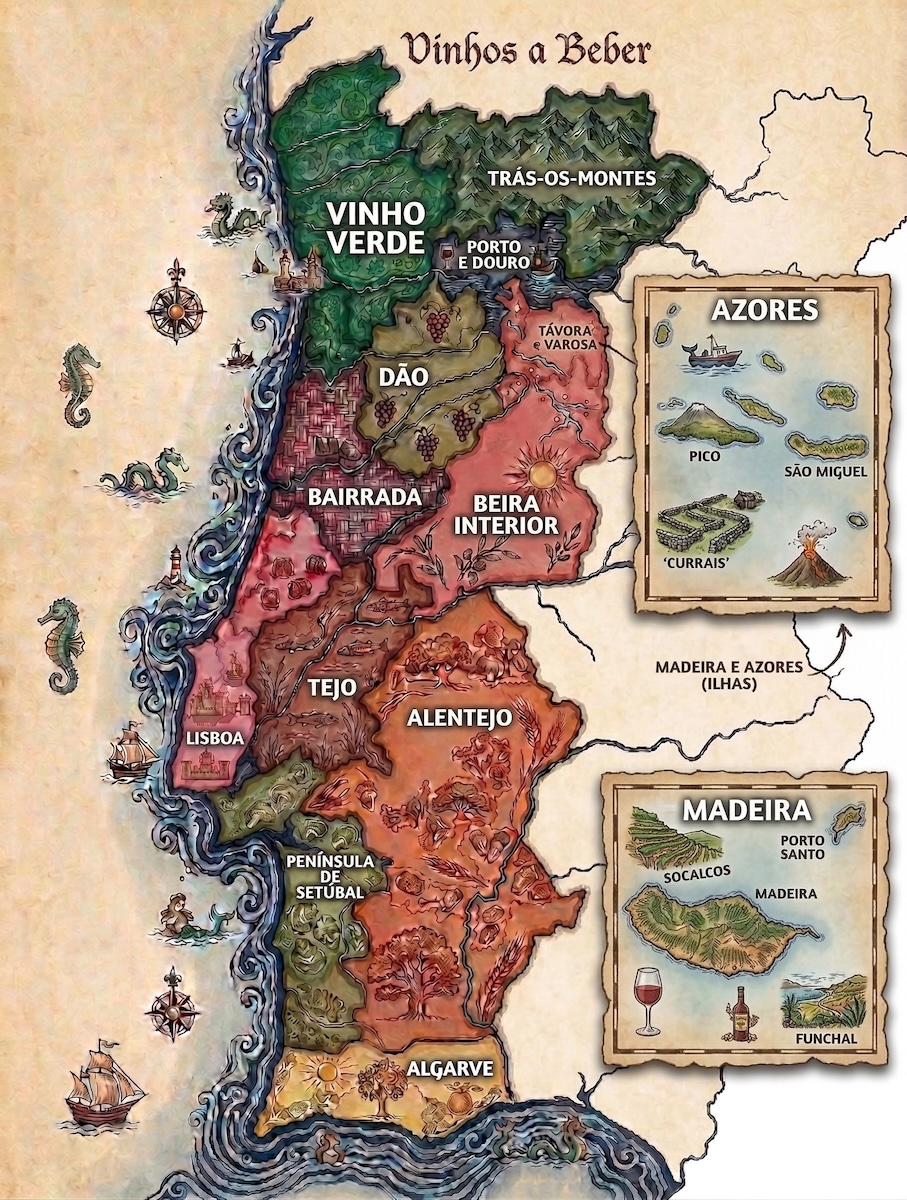
Portugal maintains a significant position in the global viticultural landscape, currently ranking 9th in the world for total area under vine with approximately 193,000 hectares of vineyards (OIV data).
This puts the country ahead of much larger nations like Chile or Australia in terms of vineyard density. Unlike the vast, sprawling estates found in New World countries, the Portuguese viticultural landscape is a dense patchwork of small, family-owned plots.
While major producers like Italy or France dominate in total volume, Portugal distinguishes itself through the highest concentration of indigenous grape varieties per square kilometer, boasting over 250 native cultivars that are rarely found anywhere else (Italy says they have 300, and it’s ok: after all, it’s not a pissing match). The diversity of grapes is driven by a complex geological mosaic and varying climatic influences ranging from the Atlantic Ocean to Mediterranean and Continental systems.
Looking at the map, the Alentejo region is the clear titan in terms of landmass, spanning nearly one-third of the country’s mainland territory and serving as a primary driver for non-fortified wine production. In contrast, Távora-Varosa and the island regions are the smallest pockets, with the former specializing in high-altitude sparkling wines. The map reveals a distinct split between the littoral and the interior; nearly half of the regions, including Vinho Verde, Bairrada, Lisboa, Península de Setúbal, and the Algarve, sit directly on the Atlantic coast. The remaining regions like the Douro, Dão, and Beira Interior are shielded by mountain ranges, creating a rugged, isolated landscape that defines the country’s traditional winemaking heritage.
Coastal regions enjoy a maritime climate characterized by high rainfall, humidity, and cooling sea breezes, which preserve acidity and produce fresh, lower-alcohol styles like those in Vinho Verde.
As you move inland past the mountain barriers of the Marão or Estrela ranges, the climate shifts sharply to continental. Here, regions like the Douro and Trás-os-Montes experience extreme temperature swings with scorching summers and freezing winters. The south, particularly Alentejo and Algarve, transitions into a Mediterranean profile with prolonged sun exposure and heat that produces Portugal’s most full-bodied and robust red wines.
Soil composition across these regions is primarily divided between ancient hard rock and younger sedimentary deposits. The northern and central interior regions are dominated by a granite and schist backbone, which forces vine roots to dive deep into rock fissures for water, imparting a distinct mineral character to Douro and Dão wines. In the coastal littoral, the geology shifts to limestone and “Barros” (heavy clay), which is particularly prevalent in Bairrada and Lisboa. The river basins of the Tejo and the plains of Península de Setúbal are defined by deep sandy soils and alluvial deposits, while the island regions of Madeira and the Azores are uniquely basaltic, shaped entirely by volcanic activity.
Let’s do a breakdown of the official wine regions as defined by the official wine authorities of the country.
1. Vinho Verde
Terroir/Climate: High rainfall, lush vegetation, and significant Atlantic influence. Cool and humid.
Major Soils: Predominantly granite.
Major Grapes: Loureiro, Alvarinho, Arinto (Whites); Vinhao (Red).
Area Under Vine: Approximately 16,000 hectares.
2. Tras-os-Montes
Terroir/Climate: Extreme continental climate with nine months of winter and three months of hell (very hot summers).
Major Soils: Granite and schist.
Major Grapes: Touriga Nacional, Tinta Roriz, Trincadeira (Reds); Codega do Larinho, Rabigato (Whites).
3. Porto and Douro
Terroir/Climate: Protected by the Marao mountains from Atlantic influence, resulting in a hot, dry continental climate. Deep valleys with steep slopes.
Major Soils: Pre-Cambrian Schist (essential for water retention in heat).
Major Grapes: Touriga Nacional, Touriga Franca, Tinta Roriz, Tinta Barroca, Tinto Cao (Reds); Viosinho, Gouveio, Rabigato (Whites).
Area Under Vine: Approximately 43,000 hectares.
4. Tavora-Varosa
Terroir/Climate: High altitude (up to 800m), providing the acidity necessary for sparkling wine production.
Major Soils: Granite and schist.
Major Grapes: Malvasia Fina, Chardonnay, Pinot Noir.
5. Dão
Terroir/Climate: Plateau surrounded by mountains (Caramulo, Montemuro, Bucaco, and Estrela), shielding it from both Atlantic winds and continental heat.
Major Soils: Decomposed granite.
Major Grapes: Touriga Nacional, Alfrocheiro, Jaen (Reds); Encruzado, Bical, Cercial (Whites).
6. Bairrada
Terroir/Climate: Maritime climate with high rainfall and cool breezes.
Major Soils: Limestone-clay (Barros) and some sandy areas.
Major Grapes: Baga (Red); Maria Gomes, Bical (Whites).
7. Beira Interior
Terroir/Climate: Most mountainous region in Portugal. High altitude and continental climate.
Major Soils: Granite and schist.
Major Grapes: Siria, Fonte Cal (Whites); Rufete, Touriga Nacional (Reds).
8. Lisboa
Terroir/Climate: Diverse region running along the coast. Strong Atlantic influence leads to wind-swept vineyards.
Major Soils: Clay-limestone and sandstone.
Major Grapes: Arinto, Vital (Whites); Castelao, Touriga Nacional (Reds).
Area Under Vine: Approximately 10,000 hectares.
9. Tejo
Terroir/Climate: Centered around the Tejo River. Features three distinct zones: Campo (floodplains), Bairro (clay/limestone hills), and Charneca (sandy plains).
Major Soils: Alluvial, clay-limestone, and sand.
Major Grapes: Fernao Pires (White); Castelao, Trincadeira (Reds).
Area Under Vine: Approximately 12,500 hectares.
10. Peninsula de Setubal
Terroir/Climate: Mediterranean climate. Coastal area with the Arrabida mountains providing protection.
Major Soils: Sandy (Poceirao) and Limestone (Arrabida slopes).
Major Grapes: Castelao (Red); Moscatel de Setubal (Muscat of Alexandria).
11. Alentejo
Terroir/Climate: Large, undulating plains covering one-third of Portugal. Very hot and dry Mediterranean climate.
Major Soils: Highly diverse; granite, schist, limestone, and marble.
Major Grapes: Aragonez, Trincadeira, Alicante Bouschet (Reds); Antao Vaz, Roupeiro (Whites).
Area Under Vine: Approximately 23,000 hectares.
12. Algarve
Terroir/Climate: Southernmost region. Sunny and tempered by the sea. Protected from north winds by mountains.
Major Soils: Sandy, limestone, and schist.
Major Grapes: Negra Mole, Castelao (Reds); Arinto, Siria (Whites).
13. Azores
Terroir/Climate: Volcanic archipelago in the Atlantic. High humidity and wind. Vines often grown in currais (stone-walled pens).
Major Soils: Basaltic volcanic rock.
Major Grapes: Arinto dos Acores, Verdelho, Terrantez do Pico.
14. Madeira
Terroir/Climate: Subtropical volcanic island. Extreme slopes (terraces).
Major Soils: Volcanic (basalt).
Major Grapes: Sercial, Verdelho, Boal, Malvasia (Noble varieties); Tinta Negra.